Hazards from exposure to welding smoke
One of the main risks of welding work is the exposure to welding smoke. The formation of welding smoke happens when the vapor of different materials, evaporated due to the high heat of the welding process, cools and thickens into tiny droplets and particles. Several factors are involved in the welding process, and accordingly, the substrate complex changes and may contain oxides of metals, silica, alumina, and fluorides, as well as the decomposition products of paint, oils, and solvents. Without extraction, welding smoke penetrates the respiratory tract, and from there travels to the bloodstream, nerve cells in the brain, spinal cord, and other organs creating short and long-term health effects.
Beryllium gas may lead to respiratory system damage, in addition to being carcinogens. Cadmium welding can cause liver damage and Emphysema. Prolonged exposure to fluorides can lead to problems in the bones and joints. Lead flakes lead to Lead poisoning. Manganese, considered to be the highest-risk welding metal, can cause Manganese poisoning (also known as Welder's Disease) and problems with central nervous system function. When working with nickel, there is a risk of skin inflammation and health problems. Metal bends can cause bronchitis and Pneumonia.
The Solution of welding smoke problem
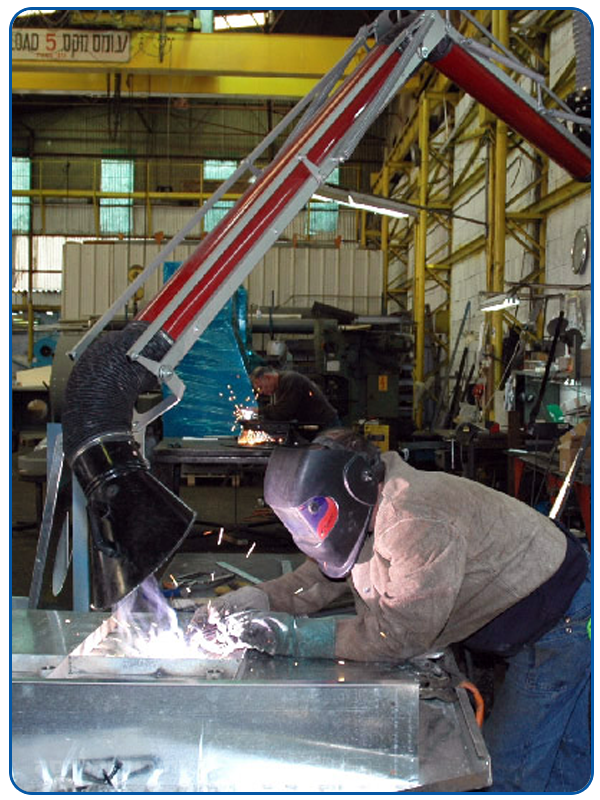
The most effective way to deal with the risk involved in welding smoke is to remove it at the source. With ventilation and pumping systems, the employer can completely prevent welding smoke from entering the welders' space. One of the most efficient tools for this purpose are suction arms for welding, which draw all welding fumes and gases specifically at the point where the welding is done, thus creating a clean and safe working environment for welders.
Click here for further reading about AIRBRAVO suction arm.





.gif)


.png)


